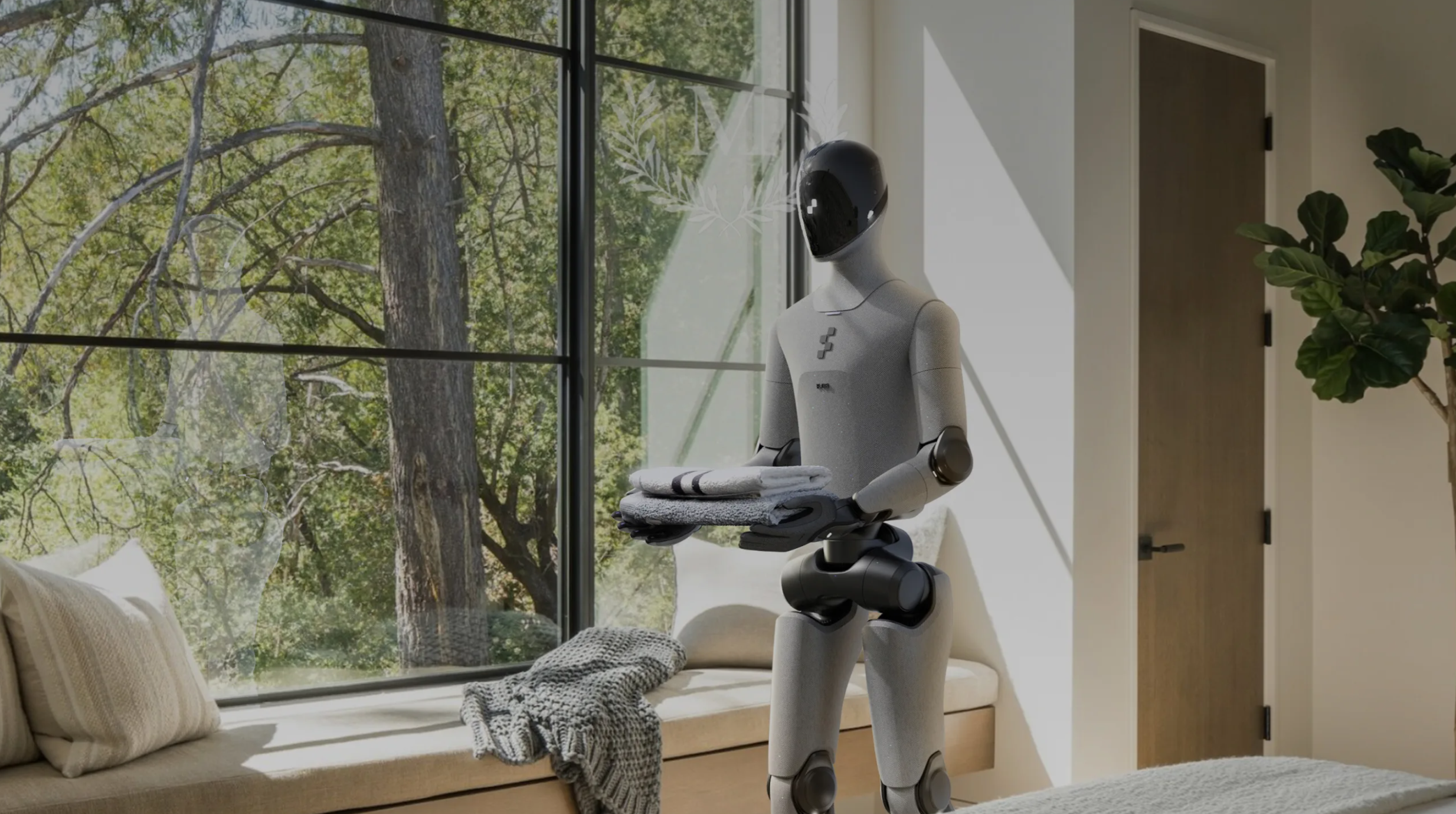
The home looks ordinary because humans have learned its rules. For a general-purpose robot, it is a dense field of unfamiliar objects, hidden states, soft materials, narrow clearances, and actions whose meaning changes by context.
FIGURE’s humanoids make that complexity visible. The company’s public direction combines a general-purpose body with embodied AI intended to understand scenes and perform useful tasks. Household demonstrations place the robot among objects designed around human size, strength, vision, and habit.
Vacuuming is a useful example. The task sounds singular. In practice, the robot must identify the correct vacuum, understand its components, locate a usable grasp, release it from storage, manage a cable or battery state, activate the right control, move the tool with effective contact, navigate furniture, and return the product safely.
Change the vacuum and the task changes. Handle diameter, center of mass, button location, articulation, visual contrast, wheel resistance, accessory storage, and feedback all affect performance. A policy trained around one product may transfer imperfectly to another.
This creates a new form of product competition. When robots begin performing tasks for people, product usability by robots can influence which models are selected, recommended, and repeatedly used. A product that is easy for a human and unreliable for a robot may lose value in an automated household.
The implication reaches every category touched by physical work: cleaning, cooking, storage, tools, furniture, packaging, personal care, and maintenance. Manufacturers need to understand compatibility at the level of a specific product, robot, task, and environment.
That evaluation can begin before widespread deployment. Product geometry and materials can be mapped against a robot’s reach, gripper, sensors, and policies. Manuals and videos can be translated into action sequences. Simulation can test varied scenes and generate logs. Physical trials can validate the most consequential interactions. As new models and end effectors arrive, the evaluation can be rerun.
FIGURE is building a robot that learns the world. Product companies have a parallel task: make their part of the world learnable.
Sources
Hero image: editorial photograph. Official brand imagery and required credits are available via the sources above.
Ainsof independently analyzes how advances in robotics affect products, tools, and physical environments. Company names and trademarks belong to their respective owners. References to third-party products do not imply endorsement or partnership.