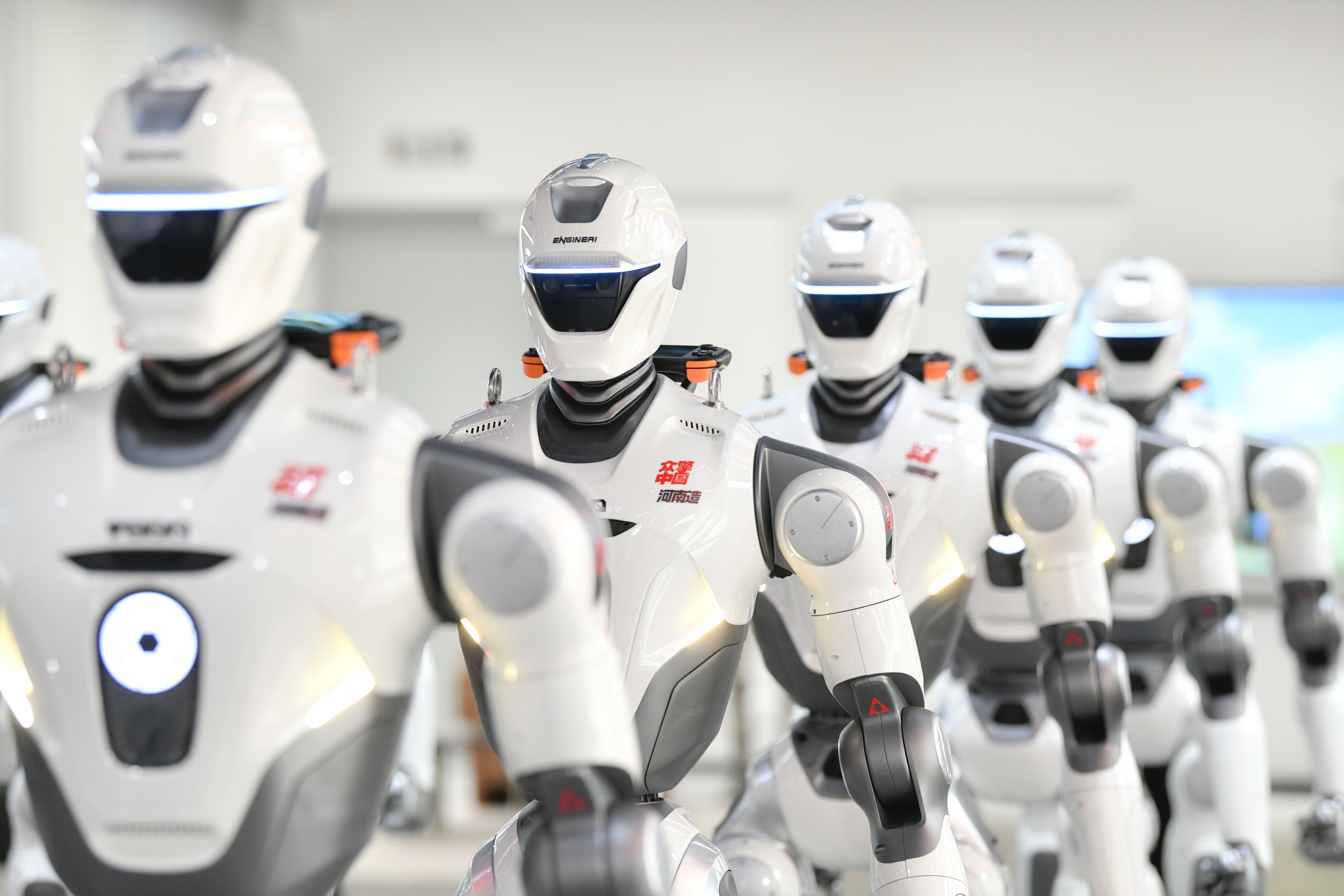
The humanoid-robot race is becoming an industrial ecosystem, and China is building many of its layers at once.
UNITREE has made dynamic humanoid hardware visible around the world. UBTECH develops full-size systems for industrial and service applications. GALBOT targets retail and logistics. FOURIER explores care and companionship. A long tail of companies is building hands, actuators, sensors, batteries, teleoperation systems, embodied models, and production capacity.
The strategic effect comes from density. More bodies create more deployments. More deployments create more data. More data improves policies and reveals hardware bottlenecks. Manufacturing scale lowers cost and makes new experiments economical. The cycle compresses the distance between demonstration and useful work.
Product companies often evaluate robotics through a single famous platform. The Chinese market suggests a broader reality. Products will encounter diverse embodiments: wheeled bases, bipeds, different heights, different hands, varied sensor stacks, and policies trained on different data. Compatibility cannot be reduced to one robot.
This diversity creates both uncertainty and evidence. If several robots fail on the same handle, closure, surface, or workflow, the product bottleneck becomes clearer. If one platform succeeds, its capability may reveal whether the limitation belongs to perception, control, hardware, or training. Comparative evaluation turns a fast-moving market into a product roadmap.
The pace also changes timing. A limitation that looks distant can disappear after a new dexterous hand, lower-cost sensor, or stronger vision-language-action model. Product redesign moves on a slower clock. Manufacturers need continuous monitoring to connect robotic advances with products already in development.
The practical response is to build a product capability model now: geometry, materials, interaction states, digital interfaces, safety constraints, and task knowledge. Test it against representative robot classes. Track capability thresholds. Identify changes with value across multiple platforms.
China’s robotics ecosystem is compressing the hardware timeline. It is also compressing the time manufacturers have to understand the new user.
Hero image: editorial photograph. Official brand imagery and required credits are available via the sources above.
Ainsof independently analyzes how advances in robotics affect products, tools, and physical environments. Company names and trademarks belong to their respective owners. References to third-party products do not imply endorsement or partnership.